
Mobile Routers
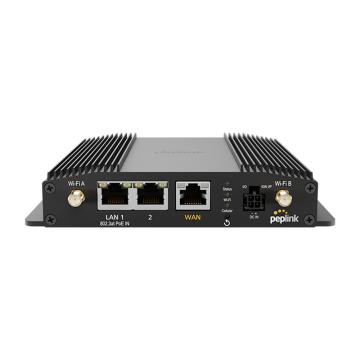
Connectivity built for the whole route, not just the depot. Mobile routers run on vehicle power, tolerate vibration and temperature swings, and hand off between cell towers as the vehicle moves.
Paygasus carries Peplink and Ericsson Cradlepoint vehicle routers, and more.
Fareboxes, validators, cameras, and dispatch share one onboard network from the first stop to the last. Dual-modem units hold two carriers at once, GPS reports fleet location to the console, and 5G units carry FirstNet Capable and T-Priority marks.
Browse the products below or request a quote that matches the router, antenna, and vehicle power kit to the fleet.
- ✔ Vehicle-rated units from the authorized source, with the manufacturer warranty
- ✔ Vehicle power, antenna, and mount quoted together
- ✔ Talk to a specialist before buying
- ✔ Shop all routers
What a Vehicle Asks of a Router
- ✔ Power that comes and goes. Vehicle DC input with ignition sensing, designed to boot the router with the vehicle and shut it down cleanly when the engine stops.
- ✔ Constant motion. Radios that hand off between towers at road speed, in a chassis rated for shock and vibration.
- ✔ Two carriers in one box. Dual-modem units run two SIMs on two networks at once, with the second carrier taking traffic where the first is weak along the route.
- ✔ Location. Built-in GPS reports vehicle position to the cloud console for fleet tracking and for tying network events to a point on the route.
- ✔ Wi-Fi on board. Wi-Fi 6 units serve crew devices and passenger Wi-Fi. Units without Wi-Fi fit a sealed equipment bay, with a separate access point covering the cabin.
5G, LTE, and the Carrier Programs
- ✔ 5G for video-heavy fleets, onboard cameras streaming to dispatch, and routes in 5G coverage. Most 5G units fall back to LTE automatically.
- ✔ LTE in CAT-4 through CAT-20 classes for fareboxes, validators, and telematics with modest traffic.
- ✔ FirstNet Capable units can operate on the FirstNet public-safety network for eligible agencies.
- ✔ T-Priority 5G units are built for T-Mobile's first-responder network slice.
- ✔ Embedded SIM on some units adds a carrier profile with no physical card swap in the field.
Installing in a Bus, Rail Car, or Truck
- ✔ Mount. Under a seat, in the equipment bay, or on a rack, with the bracket matched to the unit. See Accessories.
- ✔ Antenna. A roof or glass antenna with cellular, GPS, and Wi-Fi elements in one housing and one hole in the roof. See Antennas.
- ✔ Power. A vehicle DC kit with the fusing and ignition sensing the router expects.
- ✔ Region. Units marked Americas, Global, or North America carry different radio bands. Match the model to the country where the fleet operates.
Frequently Asked Questions
Can the same router cover a bus and a service truck?
Usually, within a fleet. The difference sits in the antenna and power kit, which the quote matches to each vehicle type.
One modem or two?
One modem where the route stays in strong single-carrier coverage. Two where the route crosses coverage gaps, or where dispatch and onboard video cannot share a single line.
Does the router track the vehicle?
Yes. Built-in GPS reports position to the cloud console, which maps the fleet and ties network alerts to location.
How is passenger Wi-Fi kept apart from fare and camera traffic?
With separate networks on the same router, set from the console, that wall passenger traffic off from fare, camera, and dispatch systems.
What does FirstNet Capable mean on a router?
The unit can operate on the FirstNet public-safety network once the agency is eligible and provisioned. The mark does not grant priority by itself; priority comes with the FirstNet service.
Will it drain the vehicle battery overnight?
Not when installed with the vehicle DC kit. Ignition sensing shuts the router down after the vehicle is switched off.